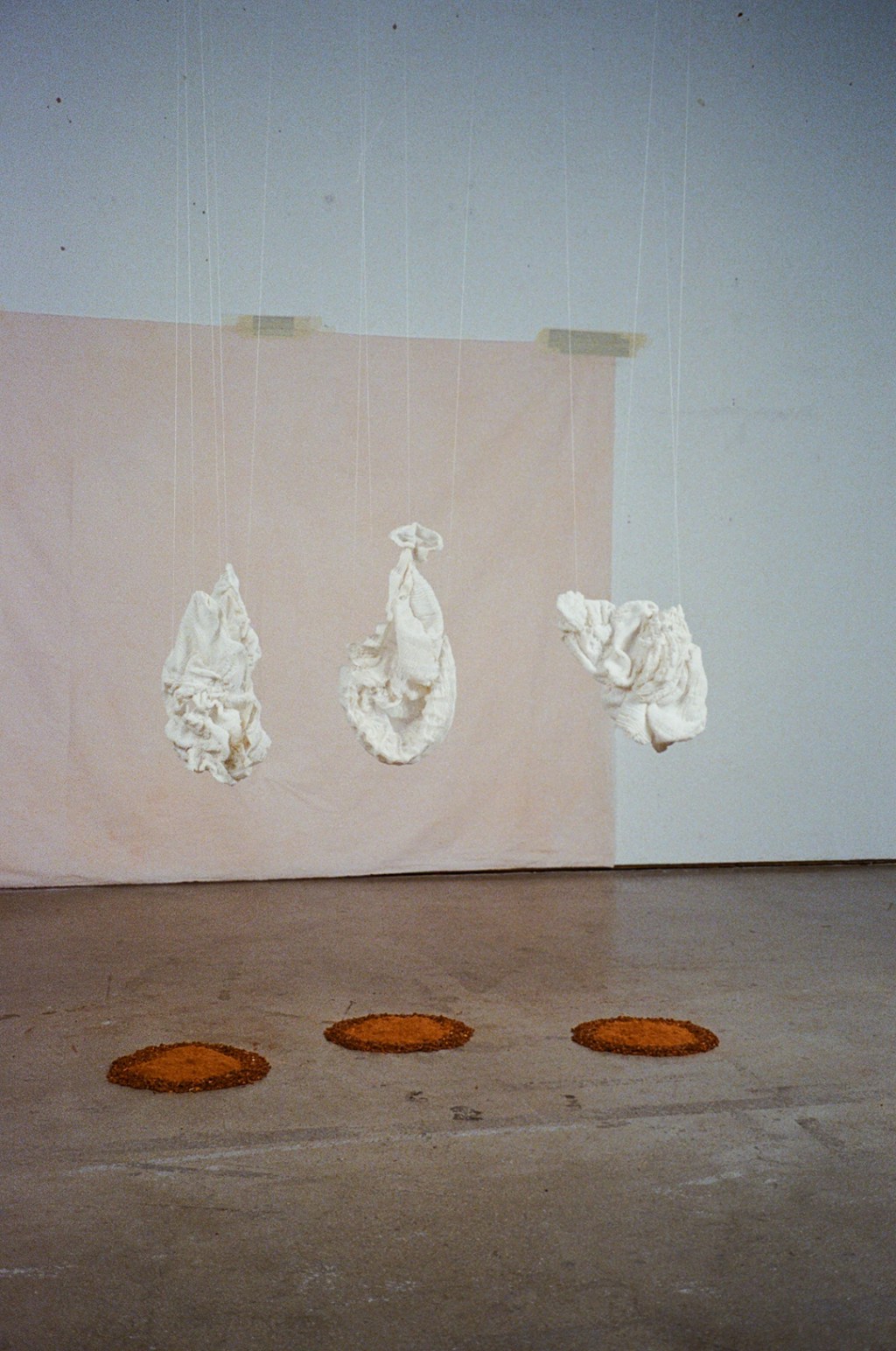
Can fabrics archive emotions? Could there be a symbiotic relationship between materials and the body? These are the questions haunting knitwear artist and researcher Emily Trenton, whose Pain Bodies series (2023 – ongoing) investigates how textiles respond to bodily experiences – such as grief and pain – and transforms them into structures of warmth and tenderness.
With a background in Industrial Design from Syracuse University, where she understood the ways human factors and empathy affected design thinking, she then studied at the Royal College of Art in London to apply these concepts to sculpture, materials, the body, and space via knit structures.
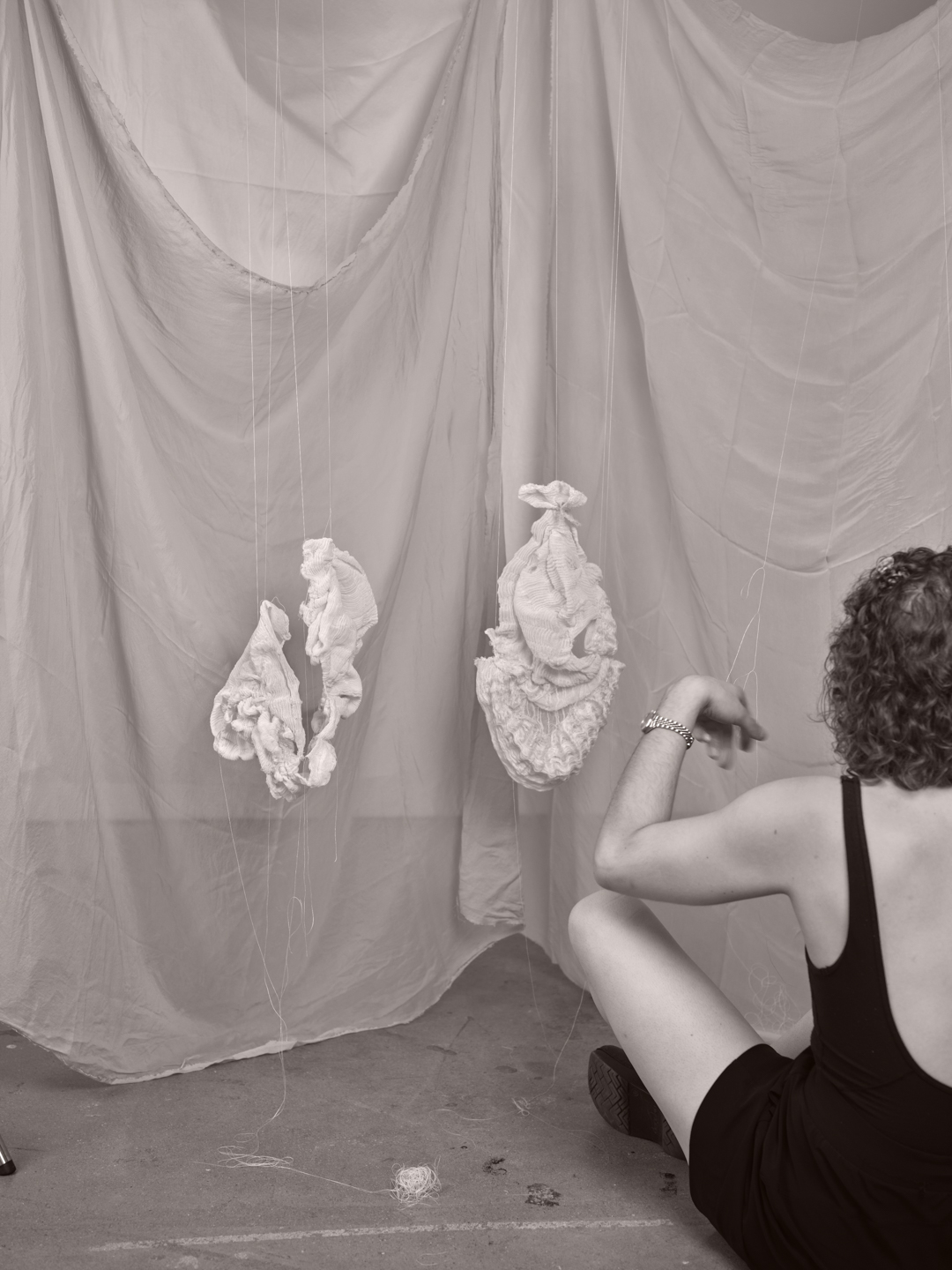
In her paper Bodily Pain: Textile Structures of Breath and Repair (2025), Trenton proposed the idea of textiles as infrastructure, ‘an intimate architecture capable of care, repair, and memory’. This directly responds to the notion that knitting is a force acting inwards, wrapping its subject like a protective layer in accordance with the shape of the knit.
But what if it worked outwards too, given the medium’s capacity to stretch? Therefore, what if life experiences like trauma can be imprinted onto the knit themselves, making intangible human things physical in the form of a ‘breathing’ cast that expands and contracts but retains its shape like a memory foam pillow?
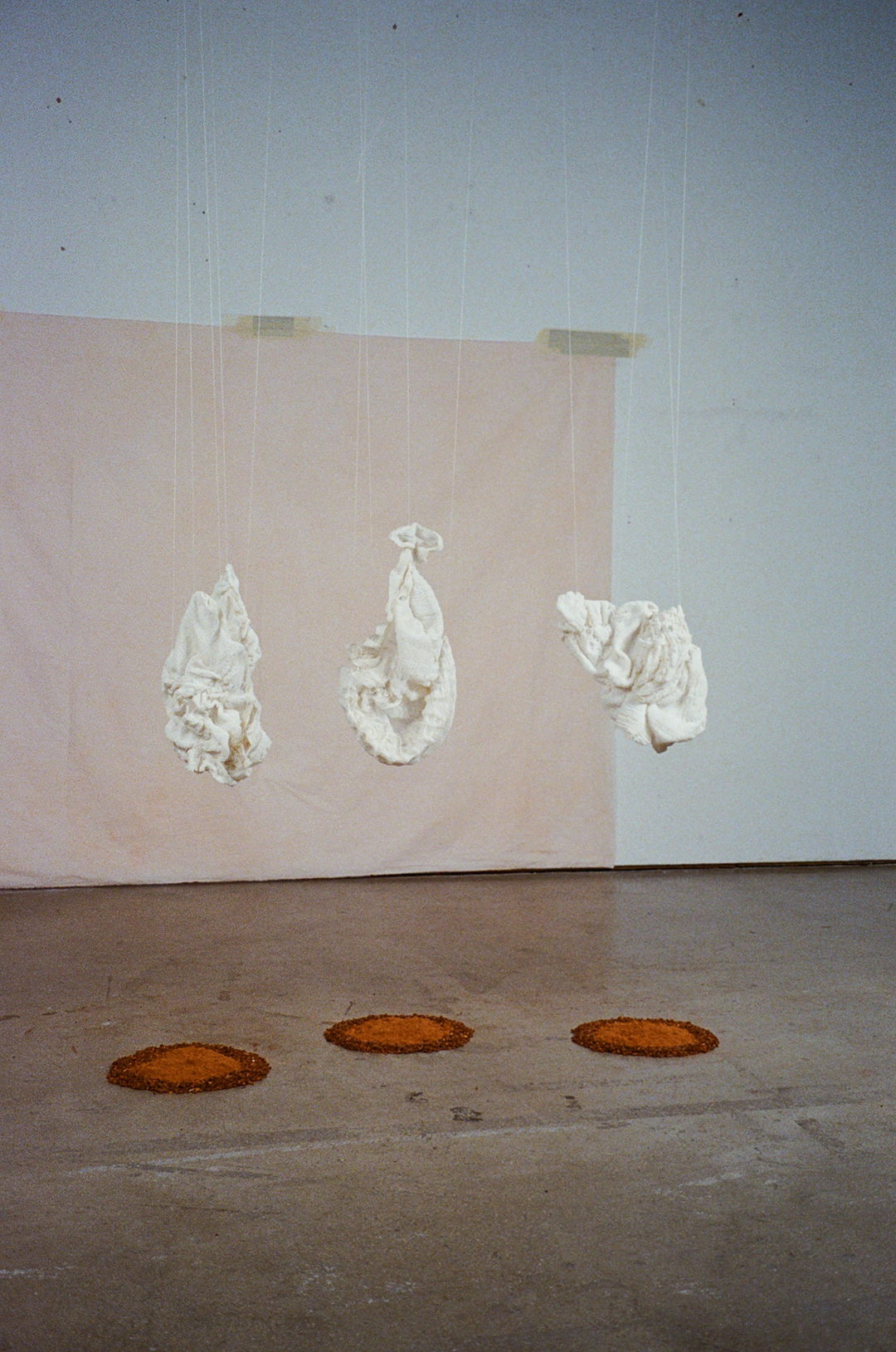
Looking at Trenton’s Pain Bodies suspended in mid-air over mounds of powdered and unground madder root, their intestinal appearance has an affective quality that is deeply unsettling. In fact, they recall Eva Hesse’s soft sculptures from the 1960s, whose use of translucent materials like latex gave them an organic, fleshy aesthetic. Unlike Hesse, Trenton’s sculptural knits may as well be corpses, which are sites of memory in themselves.
There is hope, however. By incorporating madder into the space, a traditional herbal remedy for healing wounds, Trenton has transformed the seemingly ominous shrine into a place for remedial reflection. With the knits, she wanted to explore ‘healing and revealing…of what the body holds and what the body releases.’

When seen in this renewed light, the message of Pain Bodies and Trenton’s thesis becomes clearer. As humans, we carry our emotions and experiences through life with us, growing with them but never forgetting their initial impact. Knit structures can do the same, becoming performative membranes, cavities, or vessels to be embodied; she calls them ‘architectures of care’. Indeed, Trenton cites Carolee Schneemann, Ana Mendieta, and Louise Bourgeois as artistic inspirations for their somatic explorations with materials and space.
Emily Trenton’s research-based methodology to her art practice is fascinating on so many levels. For starters, it reframes emotional experience as visible traces in time – like mechanical physics – that can be mapped and archived like a CAT scan. But it also has implications for how knit structures can be designed for practical use in medical industries and creating healing spaces for communities.
Discover more about Emily Trenton on her website.


Leave a Reply