
In a world where humanity seems intent on finding every excuse to destroy itself, the adage to ‘love thy neighbour’ seems to have lost its power. In doing so, many individuals and collectives have gone back to historical teachings to find solutions for inner peace and to express proclamations of love and support in society. The Iranian artist Farnaz Faridfar is one such artist, guided by the writings of the 13th-century Persian mystic poet Rumi whose magnum opus, the Masnavi-ye-Ma’navi, teaches us to search within ourselves to truly find love in God.
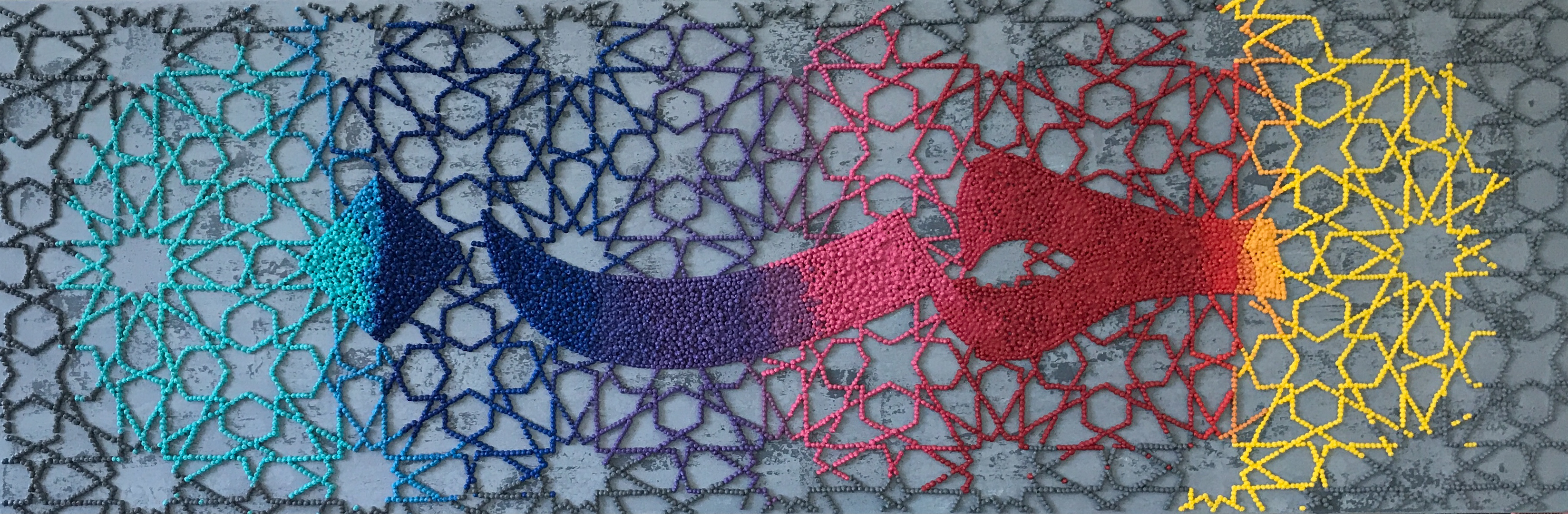
Currently based in Dubai, Faridfar has a bold, colourful approach to the artistic tradition of ancient Persia (modern-day Iran), adding texture and visual intrigue to centuries of geometric abstraction. A Love with No Boundaries (2025) takes a stylised form of the Arabic word hubb (meaning ‘love’) and sets it against a lattice of shapes she designed herself. Reading from right to left, the cascading colours from yellow to blue reflect Rumi’s seven stages of love, with each stage representing a deeper connection with the divine. The dynamic grey background, representing humanity’s imperfections, serves as a neutral position for receiving spiritual guidance and transformation.
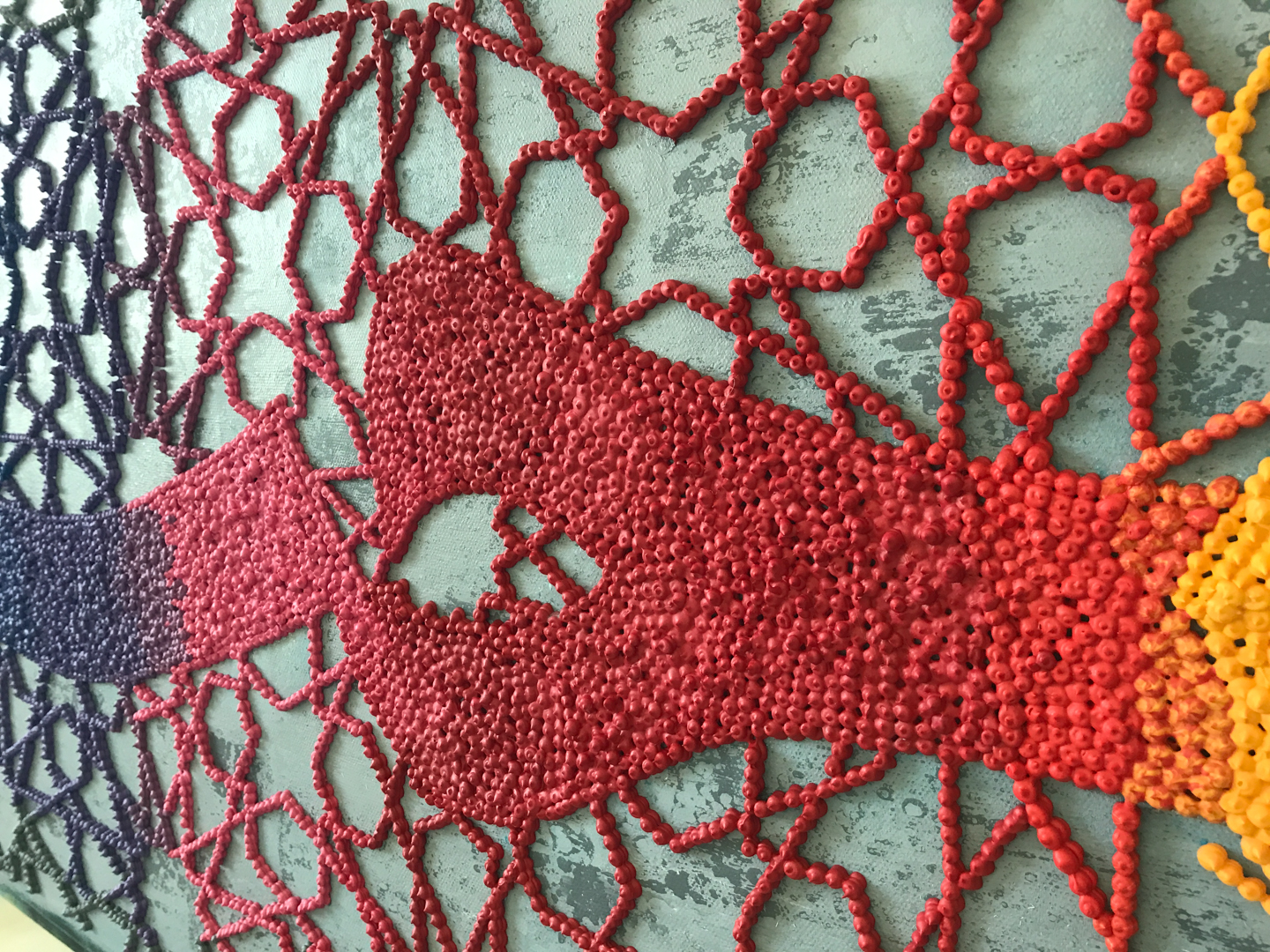
Meticulously built up with acrylic paint, her forms emerge from the surface like icing on a cake. Faridfar views her work as being quite rebellious among modern art produced in post-Islamic Iran. Although the Persian Empire had a rich figurative tradition, the Muslim conquest of Persia in the 7th century imposed strict rules forbidding the depiction of God, the Prophet Muhammad, and animate beings such as humans and animals to prevent them from becoming objects of idolatry. This resulted in a massive artistic renewal directed towards geometric abstraction. As a result, Faridfar’s crowd of impasto is a subtle nod to standing up against the constraints of conservatism in society.
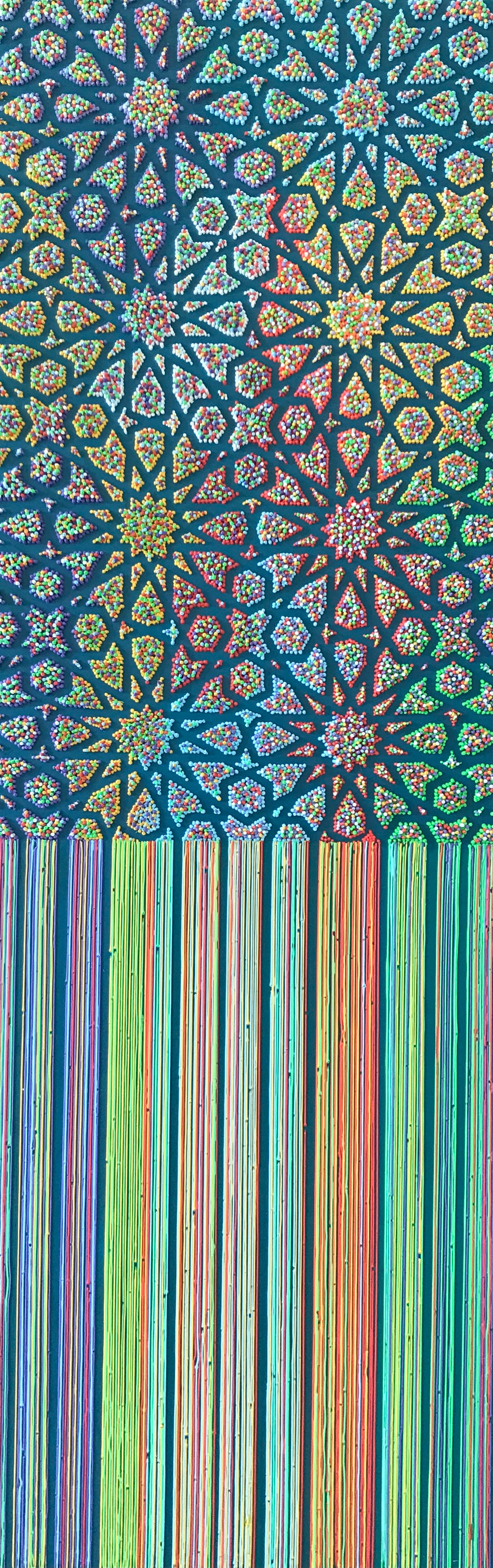
In a work like Sacred Flow (2023), Faridfar repeatedly dazzles the viewer with tessellations of 12-pointed stars, squares, and hexagons reflecting traditional Islamic art. They are composed in a kaleidoscopic arrangement of dots layered on top of each other against a dark background, producing an almost stained-glass effect. These represent the diversity of people around the world. However, this perfect system of shapes is literally falling apart in the bottom half of the composition, which consists of long lines of paint imitating paint drips. In doing so, it shows the fragility of human beings, where even those who seem very composed on the surface may be harbouring deep vulnerabilities in their mental state.
Another case in point is Silent Presence (2023). The composition – created used a syringe – consists of an ancient Persian wine-server, historically called the Saqi (or Saghi), on a gold background with colourful dots and framed inside a pointed arch. In Sufi mysticism, the saqi is a spiritual guide, serving wine that represents divine love. The act of drinking symbolises the dissolution of the ego, enabling a union with the divine. Above the arch on a dark blue sky are several constellations including Leo, whose brightest star is the kingly Regulus, one of the four Royal Stars of Persia. In fact, stars in Islamic geometry represent the divine attributes of God, including perfection, unity, and light.
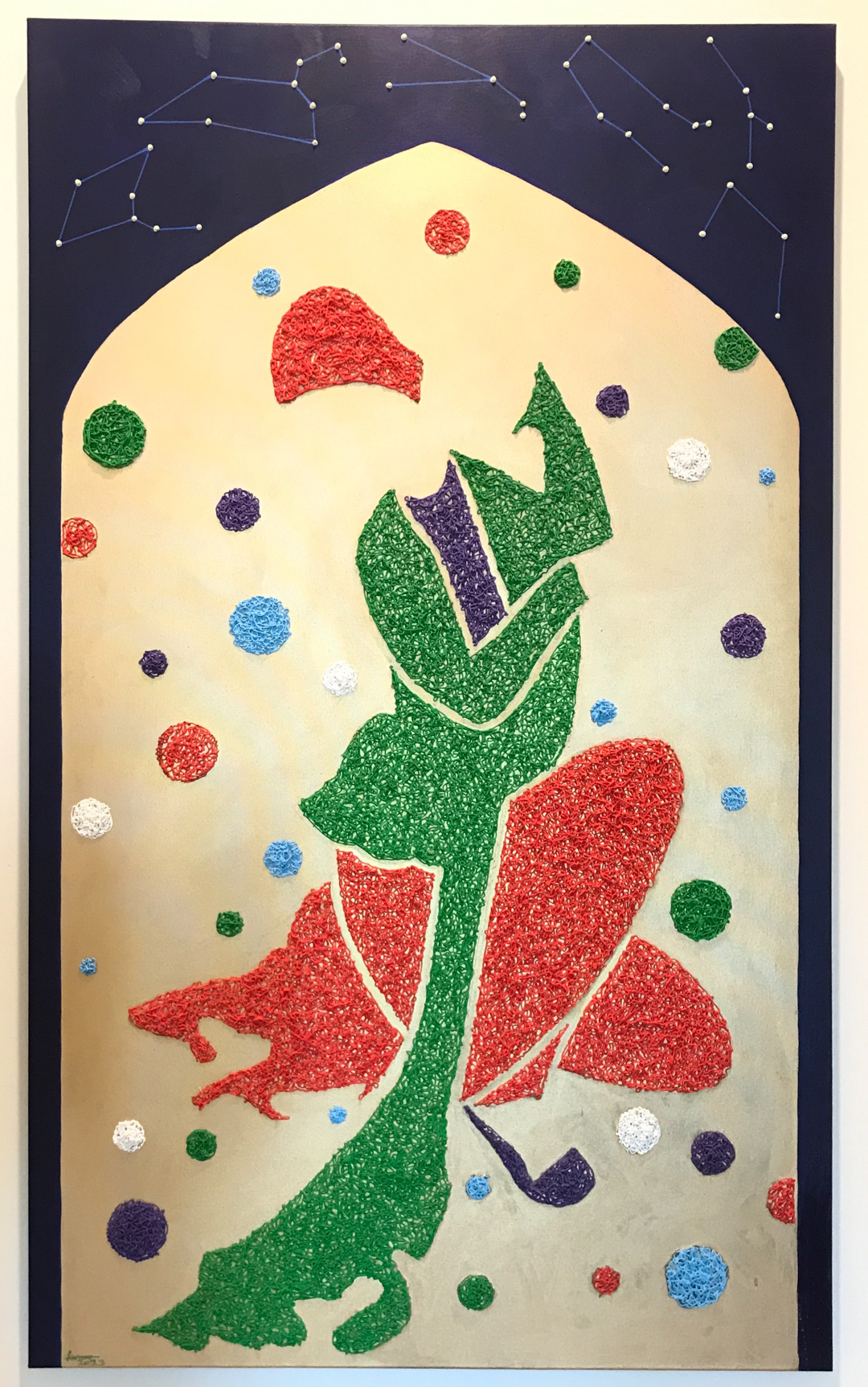
However, Faridfar portrays the saqi without features, rendering only her clothing. This erasure of her body and identity reflects the perception of women as simply objects of desire. Her individuality is simply dismissed, yet it fundamentally sits within her. By depicting her form in red and green – symbolising her sexuality and her soul, respectively – Faridfar references this continual war between the two sides. Her courtly status is also referenced in the use of the colour purple, which was extremely expensive in the ancient world, so Tyrian purple dye was therefore reserved only to clothe the elite, particularly royalty.
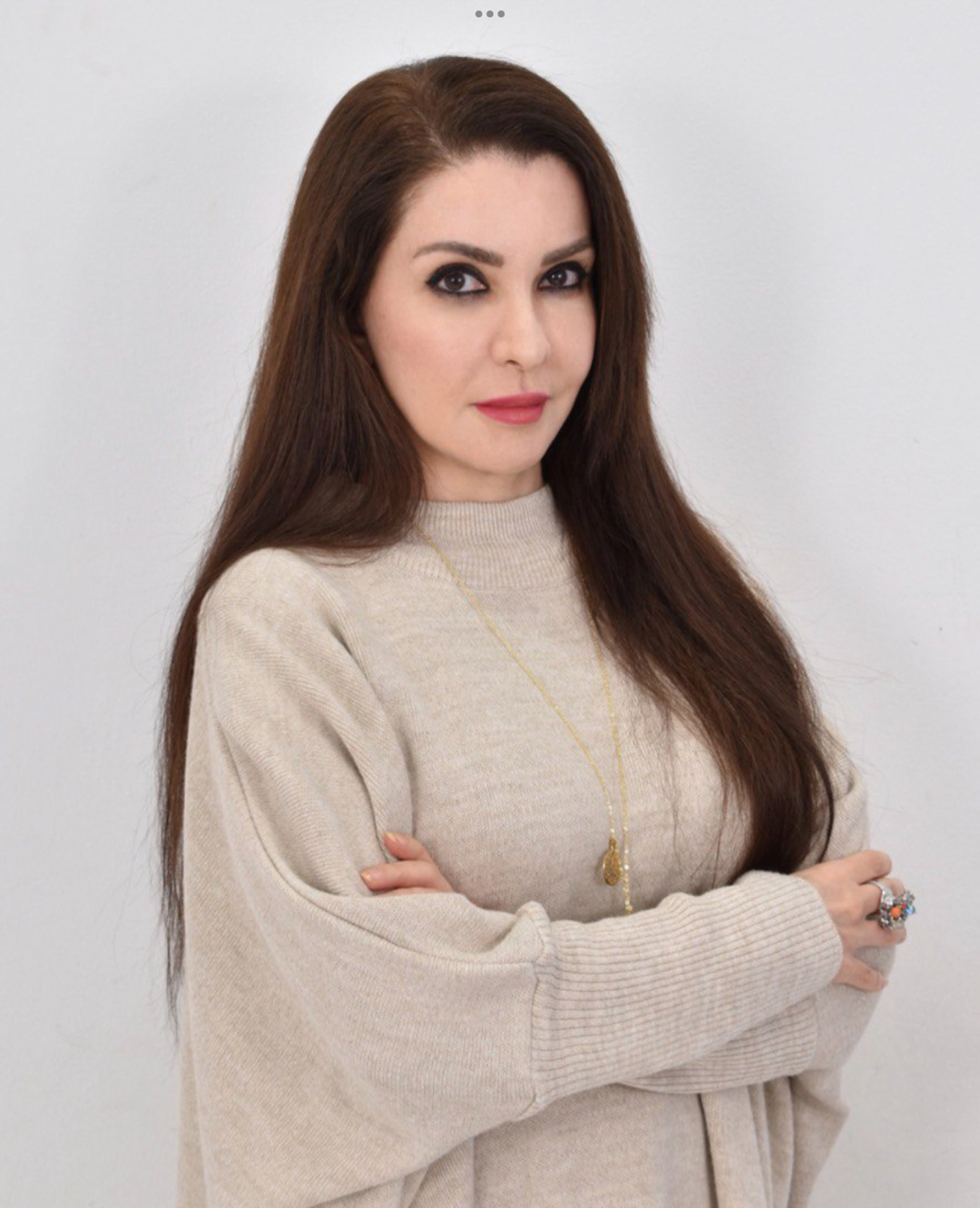
Faridfar has a conceptual way of rethinking geometric abstraction that enables her to imbue it with figurative elements in a way post-Islamic art does not allow. This confluence of ancient Persian narratives with the socio-cultural sensibilities of modern Iran gives her work relevance and meaning. The message she wants to bring out in her work is one of self-love and love of others, but it’s also more than that. Behind all the glitz and colour is a quiet feminism that speaks to those who need it most. As a result, Faridfar’s paintings provide a beautiful space for reflection – and action – in a world that has largely forgotten to love itself and its neighbours.
Collected in several private collections such as the MIA Art Collection, she has a prolific exhibition history in Dubai as well as in Europe and the United States, with forthcoming projects planned with organisations in the UK.
You can discover more of Farnaz Faridfar’s work on her Instagram.
She is due to participate in the 14th edition of the Sikka Art & Design Festival (23 January – 1 February 2026) at the Al Shindagha Historic District, Dubai.

 Nigel Ip
Leave a comment